


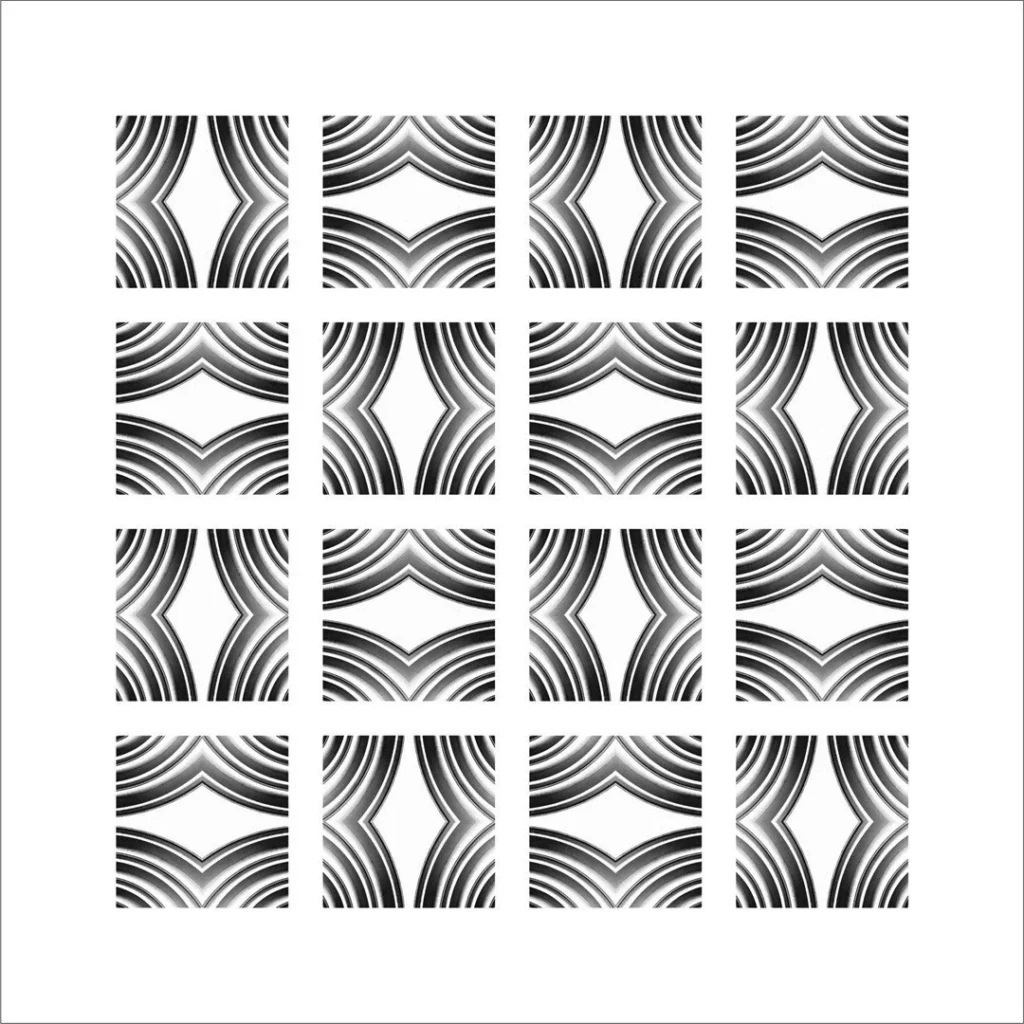


Morphological Patterns
An Interfascze of Meaning and Structure
Morphological Patterns is an investigation into photography's capacity to construct structure from the fragment. The series arises from a simple question: what happens when a portion of the world ceases to be understood as an isolated image and begins to function as a system?
Each work originates from a single photographic fragment obtained through direct observation of the environment. There is no manipulation of the scene and no prior construction of the motif. The photograph records a portion of reality that is subsequently subjected to a series of morphological operations involving rotation and axial mirroring. These operations do not seek to alter the content of the image, but to reveal structural possibilities that remained latent within the fragment itself.
The result is not a modified photograph, but a new visual entity. The image ceases to represent only what was photographed and becomes an autonomous organisation of relationships, rhythms, and symmetries. The fragment is no longer a part of the world; it becomes the minimal unit of a language.
In this sense, the series shifts photography from documentation toward system. What initially appears as documentary evidence of the environment begins to operate as a perceptual structure in which repetition, balance, rhythm, and symmetry generate new meanings. The work no longer depends on the photographed object, but on the internal relationships that construct the image.
From Fragment to Structure
Every photograph implies a selection. The frame separates a portion of the world's continuum and transforms it into a perceptual unit. Yet that selection still retains a direct connection with what it represents. In Morphological Patterns, that connection is merely the point of departure. Through symmetry and repetition, the documentary reading is gradually suspended, revealing another level of organisation. The viewer ceases to recognise a specific object and begins to perceive a system. Structure emerges as a perceptual phenomenon. We are no longer looking at a wall, a tile, a shadow, or a crack. We are looking at relationships. It is precisely through this displacement that photography stops recording the world and begins to construct it visually.
Good Form and the Organisation of Perception
The operations of rotation and mirroring produce configurations that resonate with the organisational principles described by Gestalt psychology. Repetition, continuity, and symmetry encourage the perceptual system to reorganise fragmentary information into a coherent whole. However, the aim of the series is not to illustrate Gestalt laws. Its purpose is broader. Visual organisation appears here not as a formal property, but as the manifestation of a deeper cognitive mechanism: the human tendency to construct meaning through relationships. Each pattern makes that process visible. It does not merely represent a structure; it represents the very act of structuring.
Photography as Language
If every photograph can be understood as a quotation from the world, Morphological Patterns proposes a second operation: quoting photography itself. Each fragment is detached from its original context and reorganised within a new visual grammar. Just as a word acquires different meanings depending on the sentence that contains it, a photographic fragment radically changes its significance when it becomes part of a larger structure. The series therefore shifts the minimal unit of meaning from the individual photograph to the relationship between images and forms. Photography ceases to be an isolated event and becomes syntax.
Interfascze
The series finds its conceptual foundation in Interfascze, understood as the simultaneous event between a subject, an artefact, and the purpose made possible by that artefact. In this case, the artefact is photography itself.
Fase corresponds to the material trace of the encounter between light and support.
Face manifests itself in the visible surface, where composition, contrast, and geometry articulate the first level of reading.
Faze emerges when images begin to relate to one another and activate a symbolic system that transcends each individual photograph.
Sequence organises those relationships into a visual language capable of producing thought. Meaning is not generated by the sum of the images, but by the structure that connects them.
The Viewer as Constructor of Meaning
It is precisely within the balance between order and difference that the possibility of reading emerges. Each viewer internally reorganises the relationships present within the image and constructs a personal interpretation. The work does not communicate a single message. It activates a process.
Es precisamente en el equilibrio entre orden y diferencia donde aparece la posibilidad de lectura. Cada observador reorganiza internamente las relaciones presentes en la imagen y construye una interpretación propia. La obra no comunica un mensaje único. Activa un proceso.
An Ongoing Investigation
Initiated in 2015, Morphological Patterns constitutes an open investigation into the relationships between photography, perception, design, and visual morphology. The series is organised into chapters that explore different dimensions of the same problem.
Chapter I — Structure / Black and white - Investigates formal organisation through black-and-white images.
Chapter II — Language / Colour - Introduces colour in order to expand the syntactic possibilities of the system.
Chapter III — In development / Current research - Continues the investigation, progressively shifting the focus from form toward the processes through which images produce visual thought.
More than a collection of photographs, Morphological Patterns proposes a language. Each image functions as a morpheme within a larger system, where fragment, repetition, and structure cease to be compositional resources and become operations of knowledge.